
Advertisements
Have you ever imagined learning to read and write using only your cell phone — and without spending a penny?

 Download on Google Play
  Download on the App Store
 This article shows how free apps for learning to read and write They can transform literacy. Here you will find a practical selection of free literacy appsAlso, tips for evaluating content and guidance for adapting your studies to your own pace.
With the growing supply of reading and writing applicationsThere are options for children, teenagers, and adults. Many apps offer free versions with essential activities. This makes learning to read for free easier, without financial barriers.
If you are a parent, teacher, or an adult learning to read and write, this informative and practical guide provides reasons to choose free apps. Quality criteria and real recommendations are provided. Try the suggested tools and adjust your routine according to your goals.

Main Learning
- Free apps can make starting the literacy process easier and free of charge.
- There are options of reading and writing applications for different ages and levels.
- Checking educational resources helps in choosing free literacy apps reliable.
- Combining apps with in-person activities reinforces learning.
- Monitor progress to adjust goals and maintain motivation.
Why choose free apps for literacy?
Free apps can change the way you learn to read. They are interactive and easy to use. This makes learning more fun for everyone.

Advantages of digital learning
Digital learning uses audio, animations, and exercises to teach letters and syllables. Platforms like Google Classroom and Khan Academy for Education demonstrate the power of multimedia.
Adaptive resources adjust activities to your level. This helps you learn better without needing constant lessons.
Playful elements, such as points and medals, maintain motivation. Texts with audio and expandable fonts help those who have reading difficulties.
Flexibility to learn at your own pace.
With educational apps, you can study whenever you want. This helps you adapt to your schedule. Asynchronous learning allows for short, frequent sessions.
The individual pace allows you to repeat lessons without rushing. Apps work anywhere, whether on public transport or at home.
Economics compared to in-person courses
Apps are cheaper than in-person courses. Free versions provide access to initial content at no cost. Upgrades are optional.
Fewer physical materials save money. Schools and NGOs can expand literacy programs with free apps, without spending much.
Apps for learning to read and write for free.
Many free apps help with literacy. But choosing the best one requires attention. Consider the criteria for comparison to ensure real progress in reading and writing.
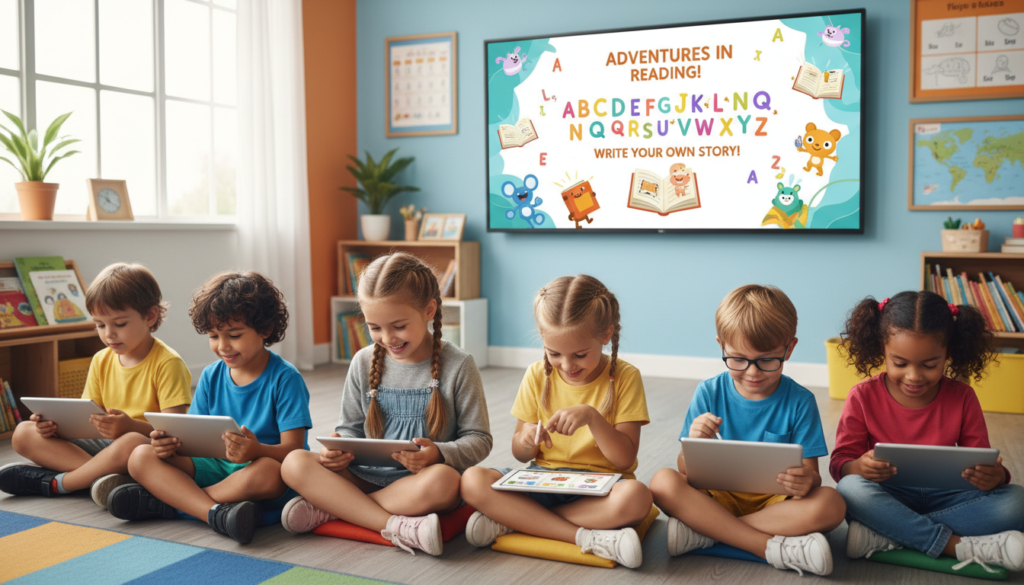
Look for activities that work with sounds and syllables. A good app should have sequential progression, from letter to sentence. Reading and writing exercises are essential, requiring reading aloud, typing, or tracing letters.
Immediate feedback is crucial for correcting errors. Multimodal content, with sound, images, and text, reinforces learning. Check assessment tools, such as performance reports and quizzes, to track progress.
How to evaluate pedagogical quality
Analyze authorship and credentials: prefer apps created by educators, speech therapists, or recognized institutions. Check if the method follows proven approaches, such as phonological awareness and systematic reading instruction.
Read reviews on the App Store and Google Play and look for case studies that show results. Do a practical test: try out the first few lessons and observe the clarity of the instructions, the consistency of the progression, and whether the feedback is relevant.
Compatibility and accessibility
Confirm App compatibility: reading, writing Available for Android, iOS, and web versions. Check storage and memory requirements, and whether there is an offline mode for use without internet.
Accessibility in educational apps should include read-aloud, zoom, high contrast, and voice navigation. This caters to users with special needs. Review privacy policies, the presence of parental controls, and the absence of intrusive advertising.
Best recommended free apps
Choosing the right app is crucial for learning quickly. Here, you'll find suggestions from educators and families. They are organized by audience and objective. Use these tips to compare resources and see if they meet your needs.
To learn letters and sounds, choose apps with colors and short lessons. Duolingo ABC has fun games and characters to help with memorization. Khan Academy Kids offers interactive activities and stories to keep their attention.
Apps like ABC do Bita use songs and rhymes to teach syllables. They are perfect for a short daily routine. They are great for those looking for safe and fun materials for children.
Apps for adults learning to read
Adults need respectful content that is applicable to everyday life. Look for apps with adapted texts, progression through levels, and practical tasks. NGO initiatives and educational programs are also good options.
Check if the app uses adult language and exercises that connect reading to real life.
Apps focused on writing and spelling.
To improve your writing, look for apps with dictation, automatic correction, and explanations of rules. Google Docs has a spell checker in Portuguese. There are also editors and apps with exercises organized by topic, such as accents and grammar.
Choose free spelling apps They should provide clear feedback and examples of use. This helps to learn from mistakes.
Educational apps with games
Games are motivating if they are educational. Syllable puzzles, word searches, and word games are effective. Look for apps that offer feedback and progress reports.
Combine games with guided activities to avoid mistakes. This way, you can have fun and focus on learning.
How to use these apps to get better results
To get the most out of free apps, create a simple routine. Spend 15–30 minutes a day using them. This keeps you interested without tiring you out.
Write down clear goals for each week. Review what you've learned frequently.
Study routine and realistic goals
Plan a week with small goals. For example, mastering the vowels in two weeks. Set goals that fit your pace.
Include breaks and reviews to avoid forgetting. Use rewards to maintain motivation. Many apps have points systems.
Combine these points with simple rewards to celebrate your achievements.
Combine apps with offline activities.
Alternate using the app with reading physical books. Telling stories aloud also helps. This reinforces word recognition and comprehension.
Practice handwriting by tracing letters. Do dictation exercises and write notes. Games with cards and phonological activities help to learn sounds.
Involve the family in reading together. Make everyday tasks a reality.
Monitoring progress and making adjustments.
Check the app reports to identify exercises with the highest error rates. Use this data to adjust the focus or increase the difficulty.
Keep a progress journal. Record goals achieved and persistent difficulties. This record makes it easier to talk to teachers or speech therapists.
If difficulties persist, seek help from a teacher or in-person program. They can provide a diagnosis and suggest specific strategies.
Conclusion
Free literacy apps show that learning to read and write is easy. They are flexible and fun. Children and adults can use these tools to improve their skills.
Choosing the right app is important. Look for one with a pedagogical foundation, an easy-to-use interface, and accessibility. This greatly helps with learning.
To see results, try different apps and study regularly. Combine digital learning with reading and writing by hand. This helps maintain interest and motivation.
Monitor your progress and adjust your goals as needed. This improves retention and motivation to learn.
To make progress, choose a good app and set a study schedule. Start with 15–30 minutes a day. See how you're progressing.
If you encounter difficulties, seek help from a teacher. Free resources can make all the difference. With dedication, you will achieve your literacy goals.